The HVRA Newsletter is printed and distributed to every Harbord Village household each April and October, filled with articles and photos about the neighbourhood. The print versions are in black-and-white, but the original colour versions are available here for online reading (and downloading if you want). Click on the headings or images for full-colour PDF files. In recent issues, use the blue-font hyperlinks to avoid typing in URLs.
NOTE: HVRA members also receive regular email messages (“eblasts”) about local events and issues. Sign up for Membership to get on the mailing list. Each message has a link for opting out.
Newsletter Spring 2026
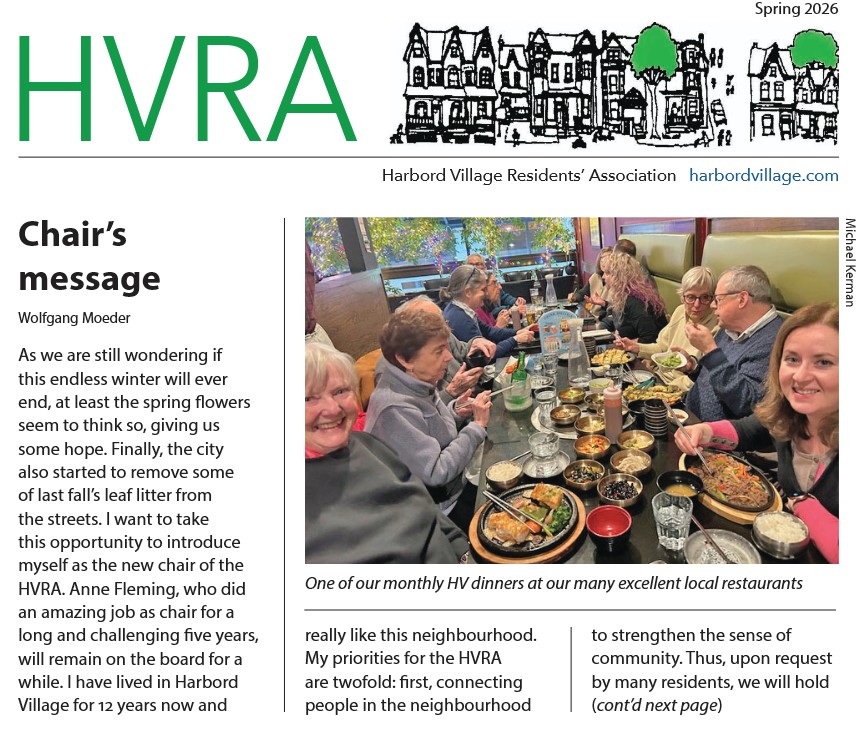 Invitation to Spring General Meeting — in person! — from 7-9pm on Tues. May 20 (location TBA soon); guest speaker Sarah Carney from UHN on Naturally Occurring Retirement Communities. Brief reports from Chair and area reps. News of recent neighbourhood cleanup and monthly dinners; Farmers’ Market starting Wed. June 3, Fall Fair Sun. Sept 13; Net Zero group news on new grants and technology, two Community Builder awardees. Centre-spread article by Sue Dexter on Queen’s Park North as a unique treasure. Encouragement to join or renew membership, volunteer for Board and committees; list of current Board members and their contact information.
Newsletter Fall 2025

Registration link for Fall Annual General Meeting (by Zoom) 7-9pm on Tues. Oct. 14; guest speaker Sean Galbraith, planner, on how new development rules will affect Harbord Village. Brief reports from Chair and area reps. Good news from Fall Fair, with photos and list of donors to silent auction; notes on Gardeners’ group, monthly diners, Net Zero project, plans for new local history project and two worthy Community Builder awardees. Pumpkin Fest will be back again on Nov. 1! Encouragement to join or renew membership, volunteer for Board and committees; list of current Board members and their contact information.
Newsletter Spring 2025

Registration link for Spring General Meeting (by Zoom) 7-9pm on Wed. May 21, guest speaker Julie LeJeune, Fort York Food Bank. Messages from Chair and area reps (with map for areas). Good news from Spring Cleanup and Coldest Night of the Year. Farmers’ Market coming soon. Invitation to monthly diners’ group. More reasons to get off fossil gas and keep on biking. Two new Community Builder awardees. List of local businesses. Encouragement to renew membership, volunteer for Board and committees; contact information for Board members. Full-colour images and live links throughout.
Newsletter Fall 2024

Registration link for Fall Annual General Meeting (by Zoom) on Tues. Oct. 16, 7-9pm; information about guest speaker Shannon Simpson. Fine day for 2024 Fall Fair. Messages from the Chair and area reps. Update on Green Plan implementation; photos of selected in-street planters. Hiatus for 2024 Pumpkin Festival. Kudos for Bob Stambula as Community Builder. List of local businesses. Encouragement to renew membership, volunteer for Board and committees; contact information for current Board members and committees. Full-colour images and live links throughout.
Newsletter Spring 2024
Registration link for Spring Meeting (by Zoom) at 7pm on Tues. May 21, 7-9pm and information about guest speaker. Huge success of fund-raising walk for Fort York Food Bank. Messages from the Chair and area reps. New measures in place for historic bur oak. NetZero project continues. Updates on local construction projects. Two new Community Builder award-winners. List of local businesses. Encouragement to renew membership, volunteer for Board and committees; contact information for current Board members and HVRA committees. Enjoy the full-colour images throughout and click on live links for further news.
Newsletter Fall 2023
 Registration link for Fall Meeting (by Zoom) at 7pm on Wed. Oct. 18. Local news about greening and Net Zero initiatives as well as road construction and development projects. Help save our ancient bur oak tree! Notes celebrating the 2023 Fall Fair and thanking donors. A new Community Builder award-winner. Lists of local businesses. Encouragement to renew membership, volunteer for Board and committees; contact information for current Board members and HVRA committees. Live links and full-colour photos throughout!
Newsletter Spring 2023
 Information and registration link for Spring Meeting at 7pm on Tues. May 16. Local news and photos about past events and information about upcoming ones, construction and development plans, NetZero initiatives, and our new Boulevard Project. Contact information for Board members and HVRA Committees. Invitations to volunteer and links for membership. Read the newsletter online to get full colour and live links.
Newsletter Fall 2022
Register for Zoom feed to Fall AGM on Tues. Oct. 18. Photos and news showing the return of the Fall Fair with a big crowd and joyful activities. The NetZero committee shares ideas and offers, and Gardeners advise on gardening to reduce carbon. Area reps report on local improvements, and the Development committee sets out news and maps showing plans for Bloor and Spadina. Contact information for Board members and HVRA Committees. invitations to volunteer, and links for membership.
Newsletter Spring 2022
 Spring General meeting online May 25. Plans for many in-person events, including return of Fall Fair. Photos throughout of recent neighbourhood activities, list of local businesses. Report from area reps; news from Net Zero, Safe Streets, Development Committees. Two new green spaces. Community Builder Award to Friedman family. Contact information for Board members, list of HVRA Committees, reasons to join HVRA and information on signup and renewal.
Newsletter Fall 2021
 Harbord Village is celebrating ways to thrive in the current “new normal.” This newsletter describes musical events in the 2021 version of our Fall Fair, lists businesses to support and enjoy, and celebrates small but significant ways HVRA has supported residents in keeping Harbord Village a good place to live. Before-and-after photos and notes display the new Robert Street Field and greenspace and a range of other neighbourhood improvements.
Newsletter Spring 2021
 Harbord Village is meeting pandemic conditions with hope and resilience. We support community organizations and local businesses and find new ways to continue community activities. Read area reports and learn how Board members work with the City on needs such as sidewalk clearing and tree-planting. Board committees outline new projects, including NetZero carbon, local greening, and safe streets. Development proposals continue apace with our input. Special Membership Flyer.
Newsletter Fall 2020

Times are still strange, but we’re strong and active in new ways. Interim Chair Anne Fleming outlines changes, including seasonal activities replacing the Fall Fair. Bob Stambula summarizes HVRA’s advocacy projects, and committees and area reps report on local news. Colour images! Link for online AGM on Thurs. Oct. 22, reminder to renew your membership, contact info for Board members and committees.
Newsletter Spring 2020
 “Stronger together”, a message from our Chair for trying times. HVRA events, area reports, and neighbourhood news. NetZero Carbon Committee has launched, and our Spring Meeting has been replaced by a webinar on the topic. Renewal of the Robert St. Field, contra-flow bike lane proposal, and much more, with colour images throughout! Plus contact info for HVRA Board members and committees.
Newsletter Fall 2019
 Highlights of 2019 HVRA Events, Fall Fair memories, Major St. refugee family update, green spaces, new businesses, Community Builder Awards, Bloor St. revitalization, master of the giant beanstalk. Colour images throughout! Area reports, printable membership form, contact info for HVRA Board members, list of HVRA committees, invitation to volunteer.
Newsletter Spring 2019
 HVRA Events, including the May 15 Spring Meeting. The value of membership and participation, Area Reports. The alarming 2017-18 tree inventory and the need to replant trees. Updates on City Council, Robert St. field, street planters, street safety, Community Builder awards, and new eateries. A Membership form, list of HVRA Committees, and HVRA Board members. NOTE: This version correctly lists Carolee Orme as NE Area Rep and Gus Sinclair as Past Chair.
Newsletter Fall 2018
 HVRA Events, with an invitation to the Oct. 17 AGM, a reminder about the value of membership, Area Reports, notes on our traffic study and other local initiatives, memories of the Fall Fair, descriptions of tree and bee studies, advice on fire prevention, and a list of new and interesting businesses. Contact information for HVRA Committees and Board members, and a Membership form.
Newsletter Spring 2018
 HVRA Events, with an invitation to the May 16 Spring meeting. Area Reports, Harbord Village Life, Area Businesses, Community Builder Awards, New Developments, Harbord History
Corner, and more! A list of HVRA Committees and Board members, and a Membership form.
Newsletter Fall 2017
 Gus Sinclair retires as chair, call for volunteers, area reports. Reports: Dragon Boat, PumpkinFest, Yard Sale, Fall Fair (thanks to donors and volunteers). Greening: in-street planters, tree re-inventory, renovated parks, Croft St. planters. Development: impasse on Sussex-Spadina residence, plans for Honest Ed’s site, discussions about U of T campus, appeals on City planning studies. And a happy outcome to skateboarding problems in the Borden St. parkette north of Central Tech.
Newsletter Spring 2017
 HVRA activities, with an invitation to the 2017 Spring Meeting. Upcoming Events, volunteers needed. Greening initiatives: in-ground plantings replacing concrete street planters, plans for Croft Street. The heritage value of Ten Editions Books. Welcoming refugees at King Edward School. Changes to school districts. Updates on development projects. Also Major St. speed humps, area reports, Board and membership information.
Newsletter Fall 2016
 Tim Grant on stepping down, not out. The 2016 Fall Fair, with 109 donors. Upcoming Events (Mon. Oct. 17 AGM, Tues. Nov. 1 PumpkinFest). New Parkettes. The artist as a very young man. Community and concrete planters. New vision for HVRA Board. New website. Greening: Croft St. and more. 2016 Yard Sale. Major St. Refugee Initiative. Tree study. Spadina building projects. Board and Membership. Newsletter editors. NOTE: The PDF file linked to the heading and image opens as a double-page spread. An alternative version lets you see it one page at a time.
Newsletter Spring 2016
 Tim Grant on board revisioning. Upcoming events (including Spring meeting). New businesses, local artist, Bloor bike lanes, greening Croft, dragon-boat racing, hospice history. Development: College St., TO Downtown, Honest Ed’s, Sussex-Spadina, U of T campus, naming College-Brunswick Parkette. Board and member information.
Newsletter Fall 2015
 AGM and silent auction Oct. 21; Fall Fair thank-yous; Pumpkin Fest Nov. 1; HV Gardeners; Greening HV; Local artist; New HVRA website coming; Toronto Noise Bylaw; The Postman; Central Tech 100 years; “A Christmas Carol” Dec. 8; Board and membership information.
Newsletter Spring 2015
 Tim Grant on pets; Central Tech compromise; Upcoming Events (including 2015 Spring Meeting); Harbord Village Gardeners; Harbord Village History project; Dragon Boat team; The Postman play; Membership matters; An artist in the community; 3Bs and Green Laneways; Development updates; Board and member information.
Newsletter Fall 2014
 Pumpkin Festival; Municipal Election 2014; City Councillor & TDSB Trustee Candidates’ OPEN LETTER TO ELECTORS (about Central Tech); New Gardeners Group; Our Paddlers Victorious; Windup Bird Cafe; HVRA historians are finalists in Heritage Toronto awards; Central Tech battle to be determined by the OMB?; End of the road for laneway naming project; 3rd Annual Yard Sale; Tree Inventory Again; Development pressure builds in Harbord Village.
Newsletter Spring 2014
 Time for Canada Post to Change; Calling all Dragon Boaters; Oral History in Harbord Village; Naming of the Lanes; and Proposed Constitutional Amendment
Newsletter Fall 2013
 Fall Fair 2013; History of the Fall Fair 1974- 2013; Historical Projects; a Harbord Village Mystery: Who are our concrete planter gardeners?; Laneway Lore: Boys of Major Lane, and the Alan Powell Laneway; and Planning Zoning Updates.
Newsletter Spring 2013
 Becoming More Inclusive; Babies in the Village; Farmers’ Market back by popular demand; Residents’ survey illuminates priorities for HVRA; Graffiti cleanup underway; University of Toronto Update: Keeping the university green; Spring Clean-Up; Harbord Village pilot project gets ahead of emerald ash borer killer.
Newsletter Fall 2012
Concerns in the Village; Pumpkin Festival; Fall Fair 2012; Murals replacing graffiti; The Nags Players; Fall Clean-Up; How the University of Toronto affects life in Harbord Village; Jennifer Keesmaat, Chief Planner; University development; EAB: the ash tree killer; Lovin’ our laneways.
Newsletter Spring 2012
Loving our laneways; Spring clean-up; New location, same great meeting; Cyril Greenland; Kensington Hospice; Original slate roofs, windows, doors, porches – oh my!; Heritage permits; Memories of Harbord Village HVRA and ACO; Rowdy clubs and bars, rooming houses.
Newsletter Fall 2011
Message from the Interim Chair of the HVRA Board; Three Harbord Villagers named to Order of Canada; Harbord Village hot for heritage; 61 Brunswick saved from demolition; Good neighbours make good porches ; Kensington Health supports heritage revival; How to heritage; Is your front door a treasure? No grant, but history project continues; Fall fair pics; Commemorating William James, photographer.
Newsletter Spring 2011
Message from the Boomerang Chair of the HVRA Board; We hope to share your memories!; HVRA Brunswick-College parkette design competition; Margaret Fairley Park revitalization update; University of Toronto update; The Mon Ton Window Gallery.
Newsletter Fall 2010
Sally Bird Park; Christie Blatchford’s Village; remembering Barbara Godard; New condo at Loretto School site.
Newsletter Spring 2010
The naming of laneways; Defeating graffiti; HERO project a high-efficiency success; Treeing the village.
Newsletter Fall 2009
Laneways; Fall Fair; Chair steps down.
Newsletter Spring 2009
HERO program; history of Margaret Fairley Parkette
Newsletter Fall 2008
Farmers Market photos; trees; pumpkins
Newsletter Spring 2008
Farmers Market, and much more
Newsletter Fall 2007
Much about trees!
Newsletter Spring 2007
Lots of stuff!
Newsletter Fall 2006
City councillor candidates
Newsletter Spring 2006
Heritage Conservation District
Newsletter Fall 2005
Cleaning up Croft Street
Newsletter Spring 2005
Front-yard tree initiative
Newsletter Fall 2004
College Street revitalization
Newsletter Spring 2004
Tree planting, neighbourhood cleanup, and more
Newsletter Spring 2004
Tree planting, neighbourhood cleanup, and more
Newsletter Fall 2003
College Street revitalization, Fall Fair….
Newsletter Spring 2003
 Our first print newsletter—black & white format, amusing drawings, and recognizable topics.Thanks to David Booz for finding his copy and scanning it for us!
- Pages 1-2: Welcome, College St. revitalization, spring cleanup.
- Pages 3-4: community composting, please no pesticides, Kensington Gardens construction.
- Pages 5-6: ROM and U of T construction plans, tree planting, member signup.