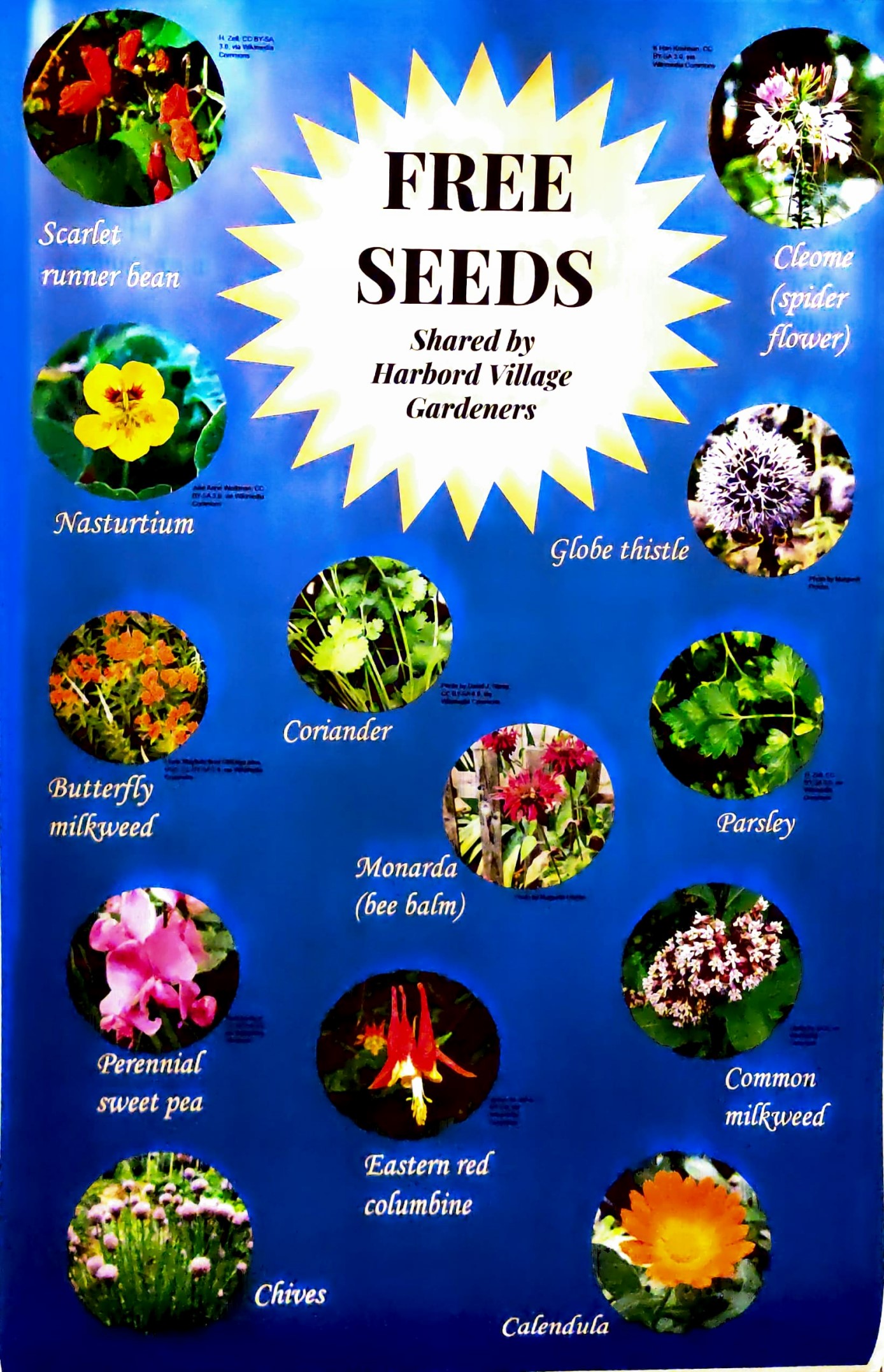
These seeds have been collected by local gardeners and are available free of charge from December 2024 onwards to members of the Harbord Village Gardeners group. Send your request to gardeners@harbordvillage.com to arrange pickup.
Winter sowing in protected outdoor containers is recommended for the first group of seeds. It’s an easy process once you create mini-greenhouses from clear plastic bottles. These two short videos show how: https://www.youtube.com/watch?v=3S8n2Cp30ug and https://www.youtube.com/watch?v=8B6VVvLytdI). The other seeds, mainly annuals, are intended for sowing outdoors in the spring.
Annotations indicate the type of plant, recommending winter sowing for most:
• 2023: seeds from year before last but still viable; other seeds harvested 2024.
• NP: Native perennial (valuable for pollinators)
• WS (listed first): Winter sow recommended to expose native perennials to a season of very cold temperatures before they germinate.
• A: annual flower, herb, or vegetable (not usually native)
NOTE: Search the web for images and further information about growing conditions and care. The poster at the bottom of this page shows images of some of the plants listed.
FOR WINTER SOWING in protected containers
- NP, WS: Anise hyssop (Agastache foeniculum). A tall native mint plant with spikes of mauve flowers that bloom from summer into the fall. A favourite of wild bees. (Two 2023 packages of yellow giant hyssop also available.)
- 2023, NP, WS: Black-eyed Susan (Rudbeckia). Another important plant for nourishing pollinators in the fall. Can be planted outdoors once the soil has warmed, will bloom second or third season. Winter sowing advances plant development; may bloom first year.
- 2023 NP, WS: Foxglove beardtongue (Penstemon digitalis). Tall native perennial, strong upright stems with bright white tubular flowers in May and June that attract bees and hummingbirds. Likes full sun. Winter sowing recommended to protect tiny seeds and seedlings.
- WS: Globe thistle (Echinops). 1.5 to 2m high perennial, dramatic blue flowers beloved by bees (though not a native plant). Blooms best in full sun; cut back after July bloom for a second bloom in September. Expose seeds to cold temp for several weeks before planting; winter sowing recommended. Plant out seedlings 70cm apart to give room for tall thick stems and large leaves.
- NP, WS: Orange milkweed — (butterfly plant, Asclepias tuberosa). Medium-height native perennial, blooms July-August, hosts Monarch butterflies. Plant in late fall by scattering fluffy winged seeds from burst pods, or plant in mid-spring. Needs well-drained soil, tolerates drought, no need for fertilizer; develops long tap root; does not spread. Blooms in second year. Easy to grow by winter sowing. Cover seeds lightly.
- NP, WS: Pink milkweed — (common milkweed, Asclepias syriaca). Tall native perennial, essential host for Monarch butterflies during July-August bloom. Exposure to cold for at least one winter is necessary. Open saved pods and scatter winged seeds in November or in early spring; winter sowing recommended. Blooms second year. Will spread by underground rhizomes.
- 2023, NP, WS: Oxeye sunflower (Heliopsis helianthoides). Tall native perennial with bright yellow-orange flowers, slightly smaller than the usual non-native sunflowers. Does well in full sun, needs little care once established. Blooms second year, flowers last into the fall.
FOR PLANTING LATER
- 2024 and 2023, A: Calendula. Annual flowering herb 30cm tall, yellow and orange daisy-like flowers attract pollinators. Sprinkle or direct sow in early spring; thin to10cm apart. Sun-loving. Blooms summer to the end of fall.Likely to self-sow once established.
- A: Cleome. 1m tall annual with white, pink or purple flowers, non-native but attracts pollinators. Sprinkle tiny seeds to plant in June, then thin out for full growth. Germinates only when days/nights are warm, then grows fast. Blooms late summer through fall. Will self-sow after first year if ground left undisturbed.
- A: Coriander. Flavourful annual herb with white flowers that bees like. Plants die out in hot weather, but more seeds can be sown in early fall. Sprinkle on ground, cover lightly; sun or partial shade.Will self-sow for future crops.
- A: Nasturtium. Annual, edible leaves and bright-coloured yellow and orange flowers that last from July into the fall. Two kinds of seeds available: for bedding plants AND for vigorous long vine needing support. Plant in ground or container in mid to late May; emerges in 10 days, blooms in 5-6 weeks. Don’t fertilize. Easy to collect seeds.
- A or P. Perennial sweet pea. Our seeds are from plants that come back several years in a row. Vine grows to 3m high and 2m wide. Pink, white, or purple flowers. Sprinkle seeds in early fall or plant in container or ground in spring. Full sun or part shade.
- A: Scarlet runner beans (“Jack and the Beanstalk”). Fast-growing annual vine, long dark-green beans. Bright red flowers attract pollinators and hummingbirds, bloom from July through fall months. Plant 10cm apart 2 cm deep early June, preferably in full sun. Provide support. Water well.
- A: 2024 and 2023: Tithonia (Mexican sunflower). Sturdy tall plant in zinnia family. Bright orange flowers are a magnet for bees. Plant late May or early June. Blooms well in full sun, flowers last from midsummer until early fall.
List prepared by Margaret Procter for Harbord Village Gardeners, September and December 2024
Poster below prepared by Amy Furness for Gardeners’ table at HVRA Fall Fair